
3D Visualisation
We analyze company workflows, bottlenecks, and revenue opportunities.
Timeline
8 weeks
Challenges
The argument about whether CGI can match jewelry photography is over. Both are capable of results a customer cannot distinguish, and both are capable of results that make a piece look cheap. Quality depends on the operator, not the medium.
The real difference is structural. Photography captures an object that exists. 3D describes an object that could exist. Photography is a cost per shoot, with cheap extra angles and expensive extra variants, and every catalog change is a new session. 3D is a cost per model, after which angles, materials, variants and future formats are close to free.

Solutions
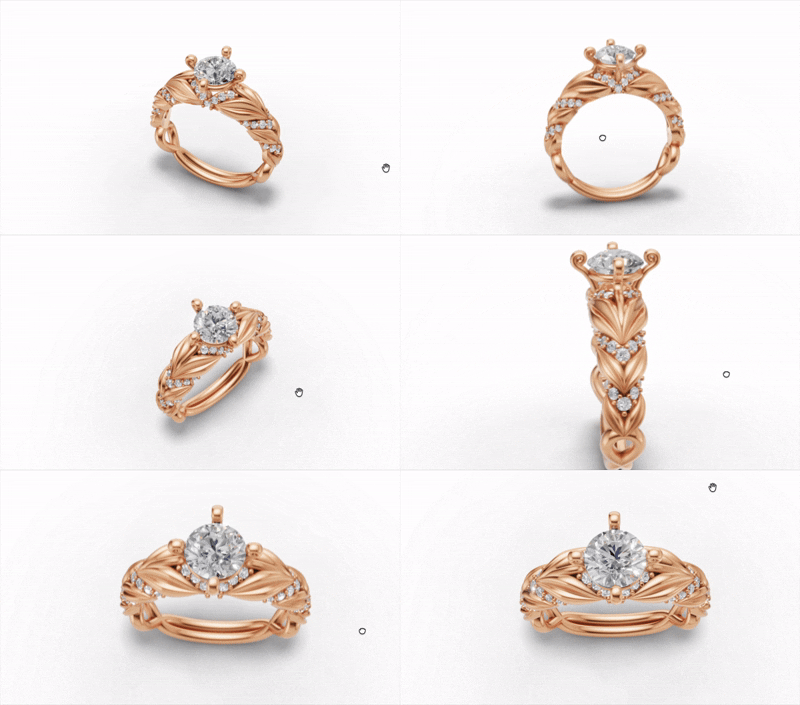
We render from your CAD and build the output as an asset library rather than a folder of finished images. The same model that produces the product page hero also drives the configurator, the in store screen and the video.
That structure is the entire point. A render commissioned as a one off image is a dead end. A model built as a reusable asset feeds your catalog for years.

The break even, on your own numbers Four figures decide it: variants per design, refresh rate, how many formats each product needs, and whether the piece physically exists yet. One or two variants, slow refresh, samples in hand, and photography is cheaper. Five or more variants, or a catalog that changes more than twice a year, and 3D wins decisively.

Selling before casting The largest financial effect has nothing to do with the cost of images. Render a collection, show it to wholesale buyers or test it on your own site, and manufacture what sells. If you have to make a piece in order to photograph it, and you wanted the photograph to decide whether the piece is worth making, only 3D breaks the circle.

Motion, at no extra shoot Video substantially outperforms static imagery for reach in jewelry, and 3D produces it from the asset you already have. Along with the things photography structurally cannot do: cross sections, scale comparisons, exploded views of a setting, a stone lit from inside.

Where photography still wins, honestly Keep it for hands, faces and lifestyle, for campaign work where the emotion is the product, for a single piece you hold and need shot today, and for estate and one of a kind stock where the photograph is evidence the object exists. Most strong catalogs run 3D for the product library and photography for the campaign.
Results
Collections reach market before production finishes, catalogues stay visually consistent across thousands of SKUs, and the cost per image falls sharply against studio photography.
Further reading: 3D Jewelry Rendering vs Photography: The Real Economics, including a break even framework for your own catalog.
none
Cast samples needed
unlimited
Metal & stone variants
weeks earlier
Time to market